Which Machine Is Best for Laser Hair Removal

Which Machine Is Best for Laser Hair Removal

If you are asking which machine is best for laser hair removal, the answer depends on more than the name of the device.

Professional laser hair removal machines differ in wavelength, power, pulse duration, cooling, spot size, treatment speed and the range of skin and hair types they are designed to treat. A machine that works well for one clinic may not necessarily be the best choice for another.

For a modern clinic treating a diverse client base, professional diode laser technology is one of the strongest all-round options for long-term hair reduction. Multi-wavelength diode systems can provide even greater flexibility because different wavelengths interact with the hair follicle at different depths and across different skin types.

Within BeautiMed's current range, the Diolux multi-wavelength diode laser is the strongest all-round option for clinics wanting advanced hair-removal capabilities, while the Diolux 01 808nm diode laser provides a focused professional solution for clinics wanting reliable 808nm diode technology.

But the right decision should still be based on your clients, treatment menu, expected volume and business model.

Let's look at what actually makes a laser hair removal machine worth investing in.

What Type of Machine Is Best for Laser Hair Removal?

For professional clinics, the main laser technologies associated with hair removal include:

  • Diode laser
  • Alexandrite laser
  • Nd:YAG laser
  • Multi-wavelength diode laser systems

Each has different optical characteristics.

The best laser hair removal machine is therefore not simply the one with the highest power specification. It is the machine that gives the practitioner enough wavelength flexibility, pulse control, cooling and treatment speed to safely work with the clinic's target client base.

For many modern aesthetic clinics, this makes diode laser technology particularly attractive.

Diode systems can combine strong follicular targeting with configurable treatment parameters, large treatment areas and integrated cooling. More advanced systems may also incorporate several wavelengths into one platform.

BeautiMed explains diode technology alongside other aesthetic lasers in its guide to the different types of lasers used in aesthetic treatments.

Why Diode Lasers Are Popular for Professional Hair Removal

Laser hair removal works by delivering light energy into the skin where it is absorbed by pigment associated with the hair.

That light energy is converted into heat, which targets structures within the hair follicle responsible for future hair growth.

This is based on the principle of selective photothermolysis: delivering enough energy to affect the intended target while limiting unnecessary thermal exposure to surrounding tissue.

A professional diode laser hair removal machine is particularly useful because diode wavelengths can penetrate effectively to the follicular level while giving practitioners control over parameters such as:

  • Energy density
  • Pulse duration
  • Treatment frequency
  • Spot size
  • Cooling
  • Treatment mode

This combination can make diode technology suitable for facial areas as well as larger treatment zones such as the legs, arms, back and chest.

For clinics, the practical advantage is not only treatment effectiveness.

Treatment speed, client comfort and predictable workflow also affect whether a machine becomes a profitable long-term part of the business.

Which Laser Wavelength Is Best for Hair Removal?

There is no single wavelength that should automatically be considered the best for every client.

Different wavelengths penetrate to different depths and interact with melanin differently.

The wavelengths most commonly discussed in professional laser hair removal include 755nm, approximately 808nm and 1064nm.

755nm

The 755nm range has relatively strong interaction with melanin.

This can make it useful when targeting pigmented hair, particularly where there is a strong contrast between the hair and surrounding skin.

Because melanin is also present in the epidermis, treatment settings and client selection remain important.

808nm

The 808nm diode laser sits in a highly practical range for professional hair-removal treatments.

It provides a balance between melanin absorption and penetration depth, which is why it is so commonly used in professional diode laser systems.

An 808nm system can be used across a broad treatment menu covering both face and body areas when appropriate parameters are selected.

1064nm

The longer 1064nm wavelength penetrates more deeply and has comparatively lower absorption by epidermal melanin.

This characteristic is particularly relevant when considering treatment across darker or more highly pigmented skin types.

For clinics serving a diverse population, having access to several wavelength characteristics can therefore be valuable.

Is a Multi-Wavelength Laser Better?

A multi-wavelength diode laser provides practitioners with greater flexibility than a system relying entirely on one wavelength.

This does not mean that adding wavelengths automatically makes a machine better.

The quality of the laser source, energy delivery, cooling, pulse control and practitioner training all matter.

However, wavelength flexibility can help a clinic adapt treatment strategies for clients with different:

  • Skin types
  • Hair thicknesses
  • Hair depths
  • Treatment areas
  • Melanin levels
  • Comfort thresholds

BeautiMed's Diolux professional laser hair removal machine currently lists 755nm, 808nm and 940nm wavelengths, with 1064nm available as an optional configuration.

It also combines multiple spot-size options, adjustable pulse duration and fast operating frequencies with contact cooling and two treatment modes.

For a clinic wanting one platform to support a broad professional hair-removal service, these are commercially important characteristics.

Which BeautiMed Machine Is Best for Laser Hair Removal?

BeautiMed currently offers two dedicated professional diode hair-removal options:

Diolux and Diolux 01.

Both are designed specifically around professional laser hair removal, but their configurations suit slightly different clinic requirements.

Diolux: Best All-Round Option for Growing and High-Volume Clinics

For clinics asking which machine is best for laser hair removal within the BeautiMed range, the Diolux is the strongest all-round choice.

It is BeautiMed's newer multi-wavelength diode system and is designed around treatment flexibility, speed and intelligent workflow.

Its current specifications include:

  • 3000W system power
  • 2000W output power
  • 755nm wavelength
  • 808nm wavelength
  • 940nm wavelength
  • Optional 1064nm wavelength
  • Multiple standard and optional spot sizes
  • 1–200ms pulse-width range
  • Frequency up to 20Hz
  • Compressor cooling system
  • Advanced contact cooling
  • Continuous treatment mode
  • Precision stamping mode
  • Hair-detection camera
  • Smart treatment programs
  • Internet connectivity and remote support

These characteristics make the system particularly suitable for clinics that expect to perform hair-removal treatments frequently or across a wide variety of body areas and clients.

Why Multi-Wavelength Capability Matters

A growing clinic rarely treats one identical client repeatedly.

One appointment may involve coarse leg hair.

The next may involve facial hair.

Another may require treatment across a different skin type or hair density.

A multi-wavelength system gives trained practitioners additional options when tailoring treatment settings to these differences.

Larger Spot Sizes

Treatment speed matters when appointments involve large body areas.

Diolux provides multiple spot-size configurations for different treatment zones.

Larger treatment windows can help practitioners cover areas such as the legs, back or chest more efficiently, while smaller treatment areas allow greater precision around regions such as the face.

This can have a direct effect on clinic workflow.

When treatment time is reduced without compromising appropriate clinical settings, a clinic may be able to accommodate more appointments within its operating day.

Fast Repetition Rate

The Diolux specification lists treatment frequencies of up to 20Hz.

For busy clinics, repetition rate is an important consideration because it influences how quickly energy can be delivered during suitable treatment protocols.

However, speed alone should never determine treatment settings.

Practitioners still need to select parameters according to skin type, hair characteristics, treatment area and the machine's clinical protocols.

Hair Detection and Smart Software

Another differentiating feature is the machine's hair-detection camera.

This is designed to assist practitioners with identifying hair density and treatment coverage.

The system also uses an Android touchscreen and software designed to support parameter selection according to characteristics such as skin colour and hair type.

Technology should not replace practitioner knowledge, but intelligent software can support consistency and make workflow easier within busy clinics.

Diolux 01: A Focused 808nm Professional Hair Removal Machine

The Diolux 01 takes a different approach.

Instead of prioritising multiple wavelengths, Diolux 01 is built around a professional 808nm semiconductor diode laser.

Its current specifications include:

  • 808nm ±10nm diode wavelength
  • 1600W large handpiece
  • 1000W small handpiece
  • Large 20 × 20mm treatment spot
  • Small 12 × 12mm treatment spot
  • 10–200ms adjustable pulse width
  • 1–3Hz frequency
  • Integrated water cooling
  • Contact cooling
  • 15.6-inch touchscreen
  • Two interchangeable treatment handpieces

BeautiMed positions Diolux 01 for Fitzpatrick skin types I through VI, including tanned skin, with adjustable settings for different treatment requirements.

Why the Dual-Handpiece Design Matters

Different treatment areas require different priorities.

Large body areas need efficient coverage.

Smaller areas require greater accuracy.

Diolux 01 addresses this with separate large and small handpieces.

The larger 20 × 20mm spot is designed to make treatment of areas such as the legs, back and chest more efficient.

The smaller 12 × 12mm spot gives practitioners more precise control when treating areas such as the face, underarms and bikini region.

For clinics looking for straightforward 808nm diode performance without requiring the broader multi-wavelength configuration of Diolux, this can make Diolux 01 a strong option.

Diolux vs Diolux 01: Which Should a Clinic Choose?

Both machines are designed for professional hair removal, but the decision becomes easier when you look at the type of clinic purchasing the equipment.
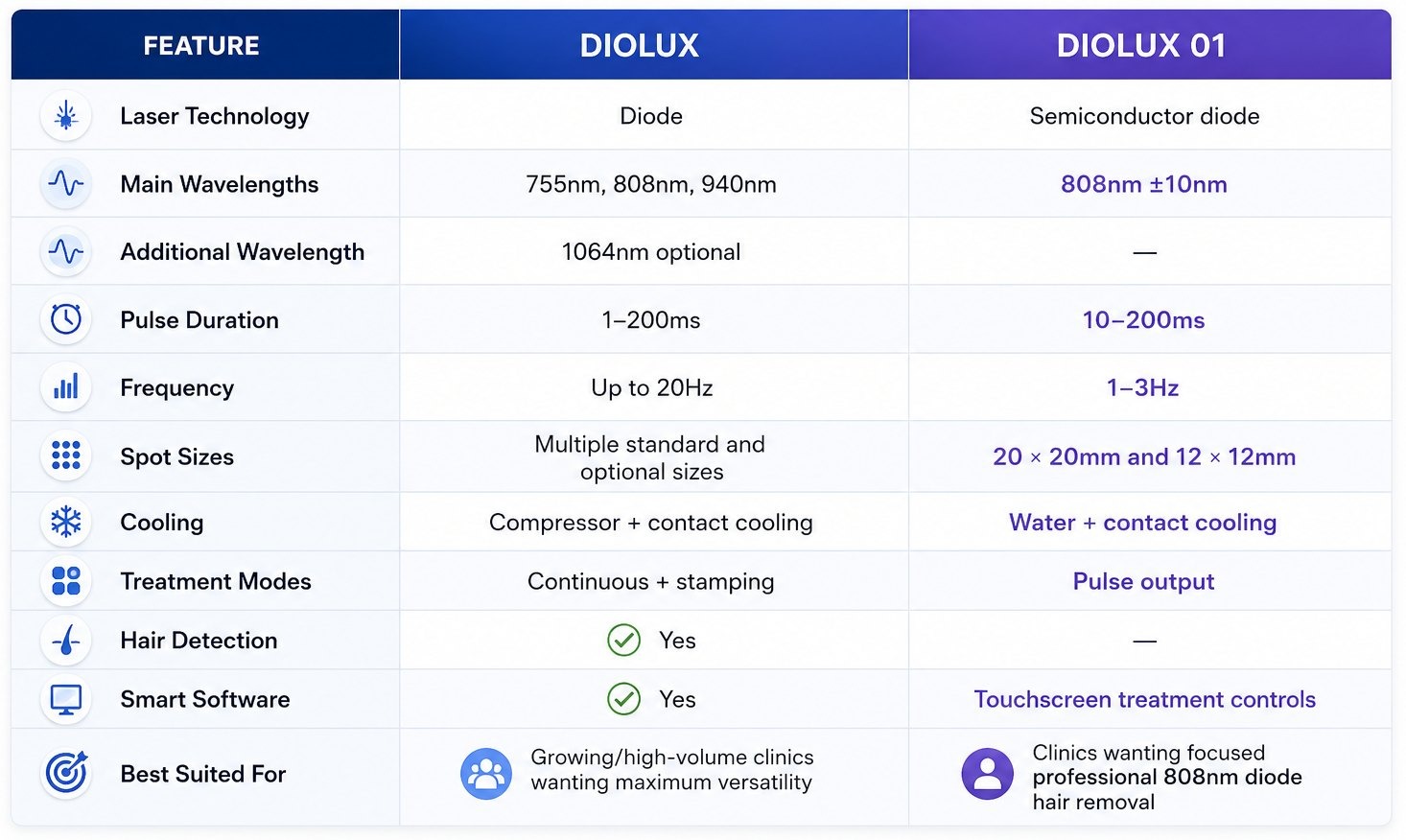
If your priority is maximum treatment flexibility, multiple wavelength options, faster repetition rates and smart workflow features, Diolux is the more advanced option.

If your priority is a dedicated professional 808nm diode platform with two practical treatment handpieces, Diolux 01 may be the better fit.

The right choice comes down to how you plan to use the machine.
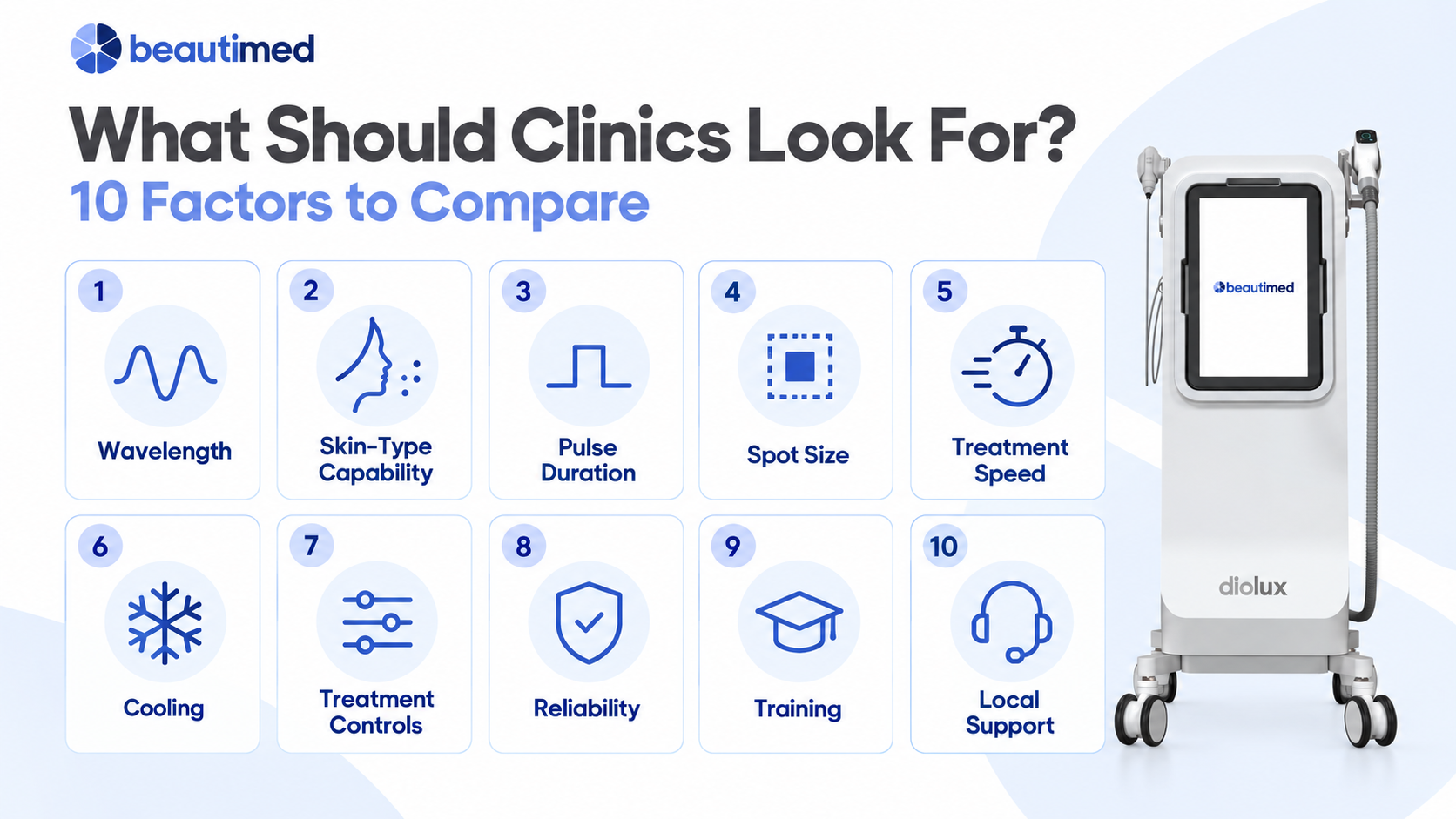
What Should You Look for in the Best Laser Hair Removal Machine?

The word “best” should never be based on one specification.

A professional clinic should assess several characteristics together.

1. Wavelength

Wavelength determines how laser energy interacts with melanin and how deeply that energy penetrates.

A clinic treating a diverse population may benefit from a system that provides more wavelength flexibility.

A clinic with a more specific treatment model may be well served by a dedicated diode wavelength such as 808nm.

2. Skin-Type Capability

Your client demographic should strongly influence your machine choice.

A laser hair removal business should consider the variety of skin types it expects to treat rather than purchasing equipment around one ideal client profile.

Appropriate client assessment and parameter selection remain essential regardless of what the machine manufacturer states about skin-type compatibility.

3. Pulse Duration

Pulse duration determines how long laser energy is delivered to the target.

Adjustable pulse widths give the practitioner greater ability to tailor treatment delivery to different hair characteristics, areas and client comfort requirements.

Both Diolux and Diolux 01 provide adjustable pulse-duration settings.

4. Spot Size

A larger spot size can improve efficiency when treating larger areas.

Smaller spot sizes provide precision.

For a high-volume hair-removal clinic, having access to several useful treatment sizes can considerably improve workflow.

5. Treatment Speed

Speed becomes increasingly important as client volume increases.

A professional machine should allow efficient treatment without forcing the practitioner to compromise appropriate treatment settings.

Consider frequency, spot size and operating mode together rather than looking at one number in isolation.

6. Cooling

Cooling is one of the most important practical elements of a professional hair-removal machine.

Laser energy creates heat.

Effective contact or integrated cooling can help manage the skin surface during treatment and improve client comfort.

Both BeautiMed hair-removal systems incorporate active cooling technologies.

7. Treatment Controls

Practitioners need sufficient control over parameters such as:

Energy, pulse width, frequency, treatment area and client characteristics.

A user-friendly interface can make daily treatments more efficient while reducing unnecessary complexity for clinic staff.

8. Reliability

Hair removal can become one of the highest-volume services within an aesthetic clinic.

The machine therefore needs to perform consistently across repeated sessions.

Downtime does not simply create a technical inconvenience.

It can lead to cancelled appointments, lost revenue and unhappy clients.

9. Training

A sophisticated machine is only as valuable as the practitioner operating it.

Proper training should cover more than simply turning the machine on.

Practitioners need to understand:

  • Laser safety
  • Client assessment
  • Contraindications
  • Skin response
  • Parameter selection
  • Hair growth cycles
  • Treatment endpoints
  • Cooling
  • Post-treatment care
  • Adverse-event management

BeautiMed provides in-person training, laser-hours assistance, licensing guidance and ongoing clinical support with its equipment.

10. Local Service and Support

The supplier matters almost as much as the machine.

Ask what happens when you need:

Technical support, servicing, replacement components, parameter guidance, troubleshooting, software assistance or additional staff training.

A machine is a long-term business asset.

Support should therefore continue after installation.

What About IPL for Hair Removal?

IPL and laser are often grouped together in conversations about hair removal, but they are different technologies.

A laser produces a more specific wavelength or defined wavelength configuration.

IPL uses a broader spectrum of light.

Professional IPL can have aesthetic applications, but clinics specifically building a laser hair removal service often look toward dedicated diode laser systems because they are purpose-built around follicular targeting and professional hair-reduction workflows.

For this reason, BeautiMed's hair-removal range is based around diode laser technology rather than treating IPL and laser as interchangeable systems.

Is 808nm the Best Diode Laser for Hair Removal?

808nm has become one of the most established wavelengths used in diode hair-removal technology because it provides a useful balance between penetration and melanin absorption.

However, asking whether 808nm is universally the “best” wavelength oversimplifies the technology.

A dedicated 808nm system such as Diolux 01 can provide a focused professional solution.

A multi-wavelength system such as Diolux can add greater flexibility by incorporating additional wavelength characteristics into the platform.

The right choice depends on the clinic.

Is More Power Always Better?

No.

Power figures can look impressive on a specification sheet, but they should not be considered in isolation.

Laser hair removal performance depends on the relationship between:

Power, fluence, wavelength, pulse duration, spot size, frequency, cooling and treatment technique.

A more powerful machine used with inappropriate parameters is not automatically more effective.

The goal is controlled and repeatable energy delivery that matches the treatment indication.

What Machine Is Best for Darker Skin Tones?

This is another situation where there should not be a one-line universal answer.

Melanin in the skin also absorbs laser energy, so treatment of more highly pigmented skin requires particularly careful wavelength and parameter selection.

Longer wavelengths generally have lower interaction with epidermal melanin than shorter wavelengths, which is one reason 1064nm characteristics are important within professional hair-removal discussions.

Clinics that routinely serve clients across a wide range of skin types should therefore pay close attention to wavelength flexibility, cooling, pulse control and practitioner education.

Never base treatment solely on a machine preset.

Proper consultation and professional assessment remain essential.

What Machine Is Best for High-Volume Laser Clinics?

High-volume clinics should evaluate different criteria from a low-volume boutique practice.

A busy clinic may prioritise:

  • Large spot sizes
  • High repetition rates
  • Fast treatment modes
  • Reliable cooling
  • Simple parameter adjustment
  • Durable handpieces
  • Easy staff training
  • Remote support
  • Strong local servicing

For this type of environment, Diolux is the stronger BeautiMed option because its multi-wavelength configuration, faster operating frequency, multiple spot sizes, continuous treatment mode and smart software are specifically suited to a more advanced workflow.

What Machine Is Best for a Start-Up Laser Clinic?

A start-up clinic needs to consider more than equipment price.

The first machine may need to generate enough treatments to support rent, marketing, staff, finance and other operating expenses.

Hair removal is attractive because it can support a repeat-treatment model and multiple treatment areas.

However, a start-up needs to balance capability against business requirements.

A clinic wanting a focused hair-removal platform may find Diolux 01 suitable.

A clinic planning to grow quickly, treat higher volumes and build a broad hair-removal client base may prefer the additional capabilities of Diolux.

Before committing to either option, work through BeautiMed's guide covering 10 questions to ask before buying a laser machine.

Which Features Matter Most for Client Comfort?

Results are important, but client experience also affects repeat bookings.

Professional laser hair removal involves controlled heating around the hair follicle. Cooling can therefore play an important role in keeping treatment comfortable.

Look for:

Effective contact cooling, adjustable treatment parameters, suitable pulse widths, appropriate treatment speed and ergonomic handpieces.

Practitioner technique is also critical.

Aggressive settings are not a substitute for a properly designed treatment plan.

Don't Choose a Machine Based Only on Purchase Price

A cheaper machine can become expensive if it creates:

  • Frequent downtime
  • Slow appointment times
  • Poor treatment consistency
  • Limited skin-type flexibility
  • High maintenance requirements
  • Difficulty accessing spare parts
  • Weak supplier support
  • Limited training

Likewise, an expensive machine does not automatically produce the best return.

The more useful question is:

What will this machine allow my clinic to do consistently over the next several years?

Consider purchase price together with utilisation, client demand, treatment pricing, machine reliability, support and potential appointment capacity.

You can explore BeautiMed's complete range of professional aesthetic and laser equipment when comparing technologies for your clinic.

So, Which Machine Is Best for Laser Hair Removal?

For most clinics, there is no universal machine that is best in every possible scenario.

The right machine depends on:

Your client demographics, skin types, expected treatment volume, treatment areas, desired wavelength flexibility, staff experience and business model.

However, for clinics looking for a professional laser hair removal machine in Australia with broad treatment flexibility, a high-quality diode laser is one of the most practical options.

Within BeautiMed's current range:

Diolux is the best all-round choice for clinics wanting multi-wavelength technology, high treatment speed, several spot-size options, intelligent software and a platform designed for growing or high-volume hair-removal businesses.

Diolux 01 is the strong dedicated 808nm choice for clinics wanting straightforward professional diode technology, dual face-and-body handpieces, adjustable pulse control and active cooling.

Neither decision should be based solely on the machine specification.

Training, treatment protocols, local servicing and ongoing supplier support are equally important parts of the investment.

Final Thoughts

When deciding which machine is best for laser hair removal, avoid choosing a device simply because it advertises the highest wattage, the largest number of wavelengths or the lowest purchase price.

Look at the complete platform.

Evaluate its wavelength configuration, energy delivery, pulse duration, spot sizes, cooling, treatment speed, skin-type capability, software, training and support.

Then compare those capabilities against the treatments your clinic actually intends to perform.

For Australian clinics looking for professional diode technology, BeautiMed's Diolux and Diolux 01 provide two different approaches to professional hair removal—from an advanced multi-wavelength platform built for versatility to a dedicated 808nm system built around reliable hair-removal performance.

If you are unsure which configuration suits your clinic, contact BeautiMed to discuss your expected client base, treatment volume and business goals before choosing your machine.

Frequently Asked Questions

Which machine is best for laser hair removal?

For many professional clinics, diode laser technology provides a strong balance of follicular targeting, versatility and treatment efficiency. Within BeautiMed's range, Diolux is the strongest all-round option for clinics wanting multi-wavelength technology, while Diolux 01 provides a dedicated 808nm diode solution.

Which is better for laser hair removal, Diolux or Diolux 01?

Diolux is better suited to clinics wanting multiple wavelengths, higher treatment speed, multiple spot sizes and smart software features. Diolux 01 is better suited to clinics wanting a dedicated 808nm diode platform with separate face and body handpieces.

Is diode laser good for hair removal?

Yes. Diode lasers are widely used for professional long-term hair reduction because their wavelengths can effectively target melanin associated with the hair follicle while providing useful penetration depth.

Is 808nm good for laser hair removal?

808nm is one of the most established wavelengths used in professional diode laser hair removal. It provides a useful balance between melanin interaction and follicular penetration.

Which laser is best for all skin types?

No single wavelength should be considered automatically best for every person. Skin type, hair characteristics, wavelength, pulse duration and treatment parameters all matter. Clinics treating a diverse population may benefit from systems offering greater wavelength and parameter flexibility.

What is a multi-wavelength diode laser?

A multi-wavelength diode system provides several wavelength options within one professional platform. Different wavelengths have different penetration and melanin-absorption characteristics, giving trained practitioners additional flexibility when planning treatments.

Is a multi-wavelength laser better than an 808nm laser?

Not necessarily. Multi-wavelength technology provides greater flexibility, while a high-quality dedicated 808nm system can be highly effective for professional hair removal. The better option depends on the clinic's target market and treatment requirements.

What should I look for when buying a professional laser hair removal machine?

Look at wavelength, pulse duration, energy range, spot sizes, cooling, repetition rate, treatment modes, skin-type flexibility, machine reliability, warranty, servicing and practitioner training.

Is cooling important in a laser hair removal machine?

Yes. Professional laser hair removal produces heat around the treatment target. Effective cooling can improve client comfort and help manage the skin surface during treatment.

What is the best laser hair removal machine for a start-up clinic?

The answer depends on budget and growth plans. A focused 808nm system such as Diolux 01 can suit clinics building a dedicated hair-removal service, while Diolux may suit businesses wanting greater wavelength flexibility and higher-volume capability.

What is the best laser hair removal machine for a busy clinic?

A busy clinic should prioritise treatment speed, spot-size flexibility, cooling, reliability and workflow. Within BeautiMed's range, Diolux is the stronger option for higher-volume practices because of its multi-wavelength configuration, higher repetition rate, multiple spot sizes and smart treatment features.


This is some text inside of a div block.

There is no universally accepted list containing a fixed number of Pico laser types.

Instead, types of Pico lasers can be differentiated according to several characteristics, including:

  • Laser source
  • Wavelength
  • Pulse duration
  • Peak power
  • Beam profile
  • Operating modes
  • Handpiece configuration
  • Fractional delivery capabilities

The most useful starting point is usually the laser source and wavelength.

Some of the major Pico laser categories include Nd:YAG picosecond lasers, Alexandrite picosecond lasers, multi-wavelength Pico lasers, hybrid laser systems and fractional Pico systems.

Let's look at each in more detail.

1. Nd:YAG Picosecond Lasers

Nd:YAG is one of the most established laser technologies used in professional tattoo-removal and pigment equipment.

Its fundamental wavelength is 1064nm. Through frequency doubling, many Nd:YAG laser platforms can also produce 532nm.

This gives a professional laser system access to two wavelengths with significantly different optical characteristics.

1064nm Pico Laser

The 1064nm Pico laser wavelength penetrates relatively deeply into the skin and has lower absorption by melanin than many shorter visible wavelengths.

For tattoo removal, 1064nm is commonly associated with targeting black and other darker tattoo pigments.

Its interaction with melanin also makes 1064nm an important wavelength when considering treatments across different Fitzpatrick skin types. Skin assessment, correct parameters and practitioner training remain essential regardless of the wavelength being used.

For clinics intending to provide tattoo-removal services, 1064nm is therefore one of the most important wavelengths to investigate when comparing Pico laser machines.

532nm Pico Laser

The 532nm Pico laser wavelength interacts more strongly with superficial pigment.

In tattoo removal, it is commonly associated with warmer colours such as red and orange pigments. Depending on the pigment and device configuration, it may also have applications involving selected superficial pigmentation concerns.

Because 532nm interacts more strongly with epidermal melanin than 1064nm, treatment planning needs to take skin type, pigment depth, energy settings and other clinical factors into account.

A professional system offering both 532nm and 1064nm wavelengths can therefore provide substantially greater flexibility than a device built around one wavelength alone.

2. Alexandrite Picosecond Lasers – 755nm

Another major Pico laser type uses an Alexandrite laser source operating at approximately 755nm.

The 755nm wavelength has relatively strong melanin absorption and sits between shorter visible wavelengths such as 532nm and the longer 1064nm Nd:YAG wavelength.

Alexandrite picosecond technology has become well known for pigmentation applications and for targeting certain tattoo pigments, including some blue and green inks.

PicoSure is one example that helped popularise the 755nm picosecond laser category.

However, there is an important distinction between PicoSure and Pico laser technology.

PicoSure is the name of a particular commercial laser platform.

Pico laser is the broader category of technology.

The same principle applies to other commercial platforms. Two machines can both be described as picosecond lasers while using completely different wavelengths, pulse widths, laser media and handpiece systems.

That is why clinic owners should compare the underlying specifications rather than comparing brand names alone.

3. Ruby and 694nm Laser Systems

The 694nm Ruby laser wavelength has a long history in pigmentation and tattoo-removal treatments.

Ruby wavelengths interact strongly with certain pigments and have been incorporated into some multi-wavelength professional laser platforms.

However, a machine offering 694nm should not automatically be assumed to deliver that wavelength using the same picosecond pulse architecture as its other wavelengths.

This introduces an important principle when comparing Pico laser types:

A multi-wavelength laser can contain several wavelengths without every wavelength necessarily operating with exactly the same pulse duration or delivery mode.

When evaluating equipment, practitioners should therefore look at the technical specifications associated with each wavelength rather than only reviewing the wavelength list.

4. Multi-Wavelength Pico Lasers

Modern professional systems increasingly use multiple Pico laser wavelengths to increase treatment versatility.

The two core wavelengths commonly found on Nd:YAG systems are:

1064nm, commonly associated with black and dark tattoo pigments and deeper targeting.

532nm, commonly used with selected superficial pigments and warmer tattoo colours.

Depending on the laser platform, additional wavelength options may include wavelengths around:

  • 585nm
  • 650nm
  • 670nm
  • 694nm
  • 730nm
  • 755nm
  • 785nm

Additional wavelengths can be particularly relevant for clinics offering laser tattoo removal, because tattoo ink does not consist of one universal pigment.

Professional tattoos can contain black, red, orange, blue, green, yellow and mixed pigments. Their chemical compositions, depth and density can also vary considerably.

One wavelength cannot necessarily interact optimally with every colour.

This is why a multi-wavelength Pico laser machine can provide a significant practical advantage for clinics treating complex or multicoloured tattoos.

It is also why asking, “What is the best Pico laser wavelength?” is not quite the right question.

A better question is:

Which wavelength is most appropriate for the pigment, depth, skin type and treatment indication in front of the practitioner?

Pico Laser Wavelength Comparison

Wavelength

Common Association

Common Professional Applications

532nm

Frequency-doubled Nd:YAG

Selected superficial pigmentation and warmer tattoo colours

585nm–670nm

Specialised or converted wavelengths

Selected tattoo ink colours depending on the platform

694nm

Ruby

Selected tattoo and pigmentation applications

730nm–785nm

Specialised laser systems

Selected resistant blue and green tattoo pigments and pigmentation applications

755nm

Alexandrite

Pigmentation and selected blue/green tattoo pigments

1064nm

Nd:YAG

Dark tattoo pigments, deeper targeting and broader skin-type applications

This comparison should be considered a general overview rather than a treatment protocol. Tattoo ink chemistry, skin type, pigment depth, fluence, spot size and other treatment parameters can all influence the clinical response.

5. Hybrid Picosecond Laser Systems

Another important category is the hybrid Pico laser system.

Instead of restricting the practitioner to one pulse architecture, a hybrid system can offer different operating modes or pulse-delivery approaches.

Why does that matter?

Because shorter is not automatically better for every treatment scenario.

Pulse duration changes how laser energy interacts with a target. Picosecond pulses can create an extremely strong photoacoustic effect, while other pulse structures may provide advantages for different treatment goals.

A system with greater control over its energy delivery can therefore give experienced practitioners more flexibility.

One example is BeautiMed's PicoMed picosecond laser machine, a Hybrid Nd:YAG Q-Switched Picosecond Laser designed for tattoo removal, pigmentation and skin revitalisation.

PicoMed incorporates 1064nm and 532nm as standard wavelengths, with additional wavelength options available, giving clinics greater scope when treating different tattoo pigments and aesthetic concerns.

For clinics that intend to offer several laser-based services, this type of versatility can be particularly valuable.

6. Pure Picosecond Laser Systems

At the other end of the spectrum are laser systems engineered specifically around extremely short pure picosecond pulse delivery.

These machines are designed to generate high peak power over very short pulse durations, creating a strong photoacoustic effect on targeted pigment.

When comparing systems in this category, practitioners should look beyond the word “Pico.”

For example, two machines may both technically operate within the picosecond range but have different:

  • Pulse widths
  • Peak power
  • Energy output
  • Wavelength combinations
  • Spot sizes
  • Handpiece options
  • Beam profiles

A 300ps machine and a 500ps machine can both be described as picosecond systems, but this does not mean their energy delivery or performance characteristics are identical.

BeautiMed's PicoMed Pro uses a pure picosecond approach with multiple wavelengths and specialised handpiece configurations for clinics focusing on advanced tattoo removal, pigmentation correction and skin rejuvenation.

The key lesson for clinic owners is simple:

Don't buy the category name. Compare the actual technology.

7. Fractional Pico Laser Delivery

Fractional Pico laser is another term commonly encountered when researching different Pico laser types.

Fractional Pico is generally a method of delivering picosecond energy, rather than an entirely separate laser source.

A fractional handpiece redistributes energy into multiple microscopic treatment zones.

Instead of using the laser only to directly target visible tattoo ink or pigmentation, fractional delivery can create controlled microscopic effects within the skin.

Depending on the device and treatment protocol, fractional picosecond technology may be used within treatment plans addressing concerns such as:

  • Skin texture
  • Acne scarring
  • Enlarged pore appearance
  • Skin revitalisation
  • Collagen remodelling

Some technologies use specialised lens arrays or optical systems to create these fractional treatment patterns.

This is particularly important when comparing equipment because two Pico laser machines might share similar wavelengths but offer very different treatment menus because of their available handpieces.

Pico Laser vs Q-Switched Laser: What Is the Difference?

This is one of the most frequently misunderstood areas of aesthetic laser technology.

Picosecond describes a unit of time and therefore refers to the approximate duration of the laser pulse.

Q-switching refers to a method of producing high-energy laser pulses.

They are not necessarily opposite categories.

Traditional Q-switched pigment lasers commonly operate in the nanosecond range, which is why Q-switched technology is frequently associated with older nanosecond tattoo-removal systems.

However, picosecond technology can also involve Q-switched laser architecture.

A more technically useful comparison is therefore often:

nanosecond pulse technology vs picosecond pulse technology

rather than assuming that every Q-switched laser and every Pico laser represents a completely separate technological family.

Pico Laser vs Nanosecond Laser

A nanosecond is one billionth of a second.

A picosecond is one trillionth of a second.

Because picosecond laser energy is delivered over a shorter period, the system can generate very high peak power and a pronounced photoacoustic effect.

This can help fragment targeted pigment and tattoo particles into smaller pieces while limiting unnecessary thermal diffusion into surrounding tissue.

However, this does not mean that every Pico laser automatically performs better than every nanosecond laser in every situation.

Treatment performance is influenced by a combination of:

  • Wavelength
  • Pulse duration
  • Peak power
  • Fluence
  • Spot size
  • Beam profile
  • Energy stability
  • Treatment technique
  • Practitioner experience

This distinction is important when clinic owners are assessing the real value of one laser platform against another.

Which Pico Laser Wavelength Is Best for Tattoo Removal?

There is no single Pico laser wavelength that is best for every tattoo.

The colour black absorbs laser energy differently from red, blue or green pigment.

Tattoo depth, pigment concentration, ink chemistry, previous treatment history and the client's skin type can also affect the response.

This is why modern tattoo-removal systems frequently include several wavelengths.

For example, a clinic specialising in tattoo removal may need to address:

Black and dark tattoos, red and orange pigments, resistant green or blue pigments, multicoloured tattoos, professional tattoos, amateur tattoos and cosmetic tattoo pigments.

This makes wavelength flexibility an important consideration for clinics intending to offer a comprehensive tattoo-removal service.

For a deeper explanation of tattoo colour, treatment sessions and laser technology, read BeautiMed's guide to laser tattoo removal.

What Type of Pico Laser Is Best for Pigmentation?

  • Choosing a Pico laser for pigmentation is more complicated than matching a wavelength to the visible colour of a skin concern.
  • Pigmentation may be epidermal, dermal or mixed.
  • Different conditions that look similar to the eye can also have very different causes.
  • Wavelength, diagnosis, pulse duration, fluence, spot size, skin type and treatment technique all influence the treatment approach.
  • Shorter wavelengths such as 532nm interact strongly with superficial melanin.
  • Longer wavelengths such as 1064nm penetrate more deeply and have lower absorption by epidermal melanin.
  • Other wavelengths, including those around 730nm and 755nm, may also be used by certain platforms for selected pigmentary applications.
  • The important point for practitioners is that a laser should not be selected according to a generic “Pico pigmentation” label.
  • Both the clinical indication and laser characteristics need to be considered.

Are Pico Lasers Used Only for Tattoo Removal?

No.

Tattoo removal is one of the applications most strongly associated with Pico laser technology, but modern picosecond devices can have a broader role within professional aesthetic clinics.

Depending on the device, handpiece and appropriate treatment protocols, a Pico laser may be used across treatment categories involving:

  • Tattoo removal
  • Pigmentation correction
  • Skin revitalisation
  • Acne-scarring treatments
  • Fractional skin treatments
  • Texture improvement

This versatility is important commercially as well as clinically.

A machine that can support multiple high-demand treatment categories can potentially be utilised more frequently than a device purchased for only one service.

For clinics comparing different technologies rather than only Pico devices, BeautiMed's aesthetic laser machine guide provides a useful overview of the wider laser landscape.

What Matters More Than the Word “Pico”?

One of the biggest mistakes a clinic can make is assuming that all picosecond systems are equal.

They are not.

When comparing Pico laser machines in Australia, consider the following factors.

Wavelengths

Find out which wavelengths the device provides and which target chromophores or treatment categories they are designed to address.

Pulse Duration

Check the actual pulse width rather than relying solely on the word “picosecond” in the product name.

Peak Power

Very short pulses can create high peak power, contributing to the photoacoustic interaction used in pigment fragmentation.

Spot Size

Adjustable spot sizes allow greater treatment flexibility and influence penetration, energy density and treatment speed.

Beam Profile

Consistent distribution of energy across the treatment spot is an important characteristic of professional laser equipment.

Handpieces

Standard, fractional, specialised wavelength and adjustable-spot handpieces can considerably expand the services available from one machine.

Energy Stability

A professional clinic needs predictable output across repeated pulses and high treatment volumes.

Practitioner Training

Advanced technology should be accompanied by comprehensive education and clinical guidance.

Laser specifications alone cannot compensate for inadequate practitioner knowledge.

Local Technical Support

Warranty coverage, servicing, replacement components and access to technical support should all be considered before investing.

Licensing and Regulatory Requirements

Requirements for laser use vary across Australia. Clinics should understand the regulations applicable to their state, practitioner and intended treatments.

BeautiMed provides training, laser-hours assistance, licensing guidance and ongoing clinical support alongside its equipment, helping clinics consider more than simply the initial machine purchase.

PicoMed vs PicoMed Pro: Two Different Pico Approaches

BeautiMed offers different professional Pico laser configurations to suit different clinic requirements.

The PicoMed is a Hybrid Nd:YAG Q-Switched Picosecond Laser designed for clinics looking for flexibility across tattoo removal, pigmentation breakdown and skin revitalisation.

It provides 1064nm and 532nm wavelengths as standard, with additional wavelength and handpiece options available.

The PicoMed Pro takes a pure-picosecond approach and combines ultra-short pulse delivery with multiple wavelength and handpiece options for clinics focusing on advanced tattoo removal, pigmentation correction and skin rejuvenation.

The better option is not determined by a single specification.

The right choice depends on the treatments the clinic intends to offer, its client base, expected treatment volume and long-term growth strategy.

How to Compare Different Pico Laser Types

When comparing different Pico laser types, use a structured approach.

First, identify the laser source.

Next, examine the available wavelengths.

Then compare the actual pulse duration and peak power.

After that, investigate the spot sizes, beam profile and handpieces available.

Finally, look beyond the hardware and examine training, warranty, servicing, regulatory support and ongoing clinical assistance.

This makes it much easier to compare systems based on their real clinical and business capabilities instead of marketing terminology.

Final Thoughts

Understanding Pico laser types requires looking beyond brand names.

A Pico laser should be assessed according to its underlying technology, including its laser source, wavelengths, pulse architecture, peak power, spot sizes, beam delivery and treatment handpieces.

Nd:YAG Pico systems commonly provide wavelengths such as 1064nm and 532nm. Alexandrite picosecond systems commonly operate around 755nm. Multi-wavelength systems can expand the range of tattoo pigments and treatment indications a clinic can address, while fractional delivery can broaden the role of picosecond technology into advanced skin treatments.

For clinic owners, however, technical specifications are only part of the decision.

Training, clinical guidance, equipment reliability, servicing, regulatory assistance and ongoing supplier support can have just as much impact on the long-term success of the investment.

If you are comparing professional Pico laser machines for your clinic, explore BeautiMed's range of aesthetic and laser equipment or contact BeautiMed to discuss the Pico technology and machine configuration that best matches your treatment goals.

Frequently Asked Questions About Pico Laser Types

How many types of Pico lasers are there?

There is no fixed number of Pico laser types because picosecond lasers can be classified according to laser medium, wavelength, pulse duration, operating mode and delivery system. Major categories include Nd:YAG Pico lasers, Alexandrite Pico lasers, multi-wavelength systems, hybrid laser systems and fractional Pico platforms.

What are the main Pico laser wavelengths?

Some of the most commonly discussed Pico laser wavelengths include 532nm, 755nm and 1064nm. Depending on the platform, additional wavelengths such as 585nm, 650nm, 694nm, 730nm or 785nm may also be available.

What is an Nd:YAG Pico laser?

An Nd:YAG Pico laser uses an Nd:YAG laser medium. Its fundamental wavelength is usually 1064nm, while many systems can also generate 532nm through frequency doubling. These wavelengths are commonly used in professional tattoo-removal and pigmentation applications.

Is PicoSure the same as a Pico laser?

No. PicoSure is the name of a specific commercial picosecond laser platform. Pico laser is the broader technology category referring to laser systems delivering pulses within the picosecond range.

What is a multi-wavelength Pico laser?

A multi-wavelength Pico laser provides more than one wavelength from the same platform. Different wavelengths interact differently with tattoo pigments, melanin and other chromophores, giving practitioners greater flexibility across different treatment indications.

Which Pico laser is best for tattoo removal?

There is no single best Pico laser for every tattoo. Tattoo colour, pigment chemistry, depth, skin type, pulse duration, wavelength, fluence and practitioner technique all influence treatment. Clinics treating multicoloured tattoos may benefit from systems with several wavelength options.

Is 1064nm or 532nm better?

Neither is universally better.

The 1064nm wavelength is commonly associated with darker tattoo pigments and deeper targeting, while 532nm interacts strongly with more superficial pigment and selected warmer tattoo colours.

Professional multi-wavelength systems commonly provide both because they serve different purposes.

What is a fractional Pico laser?

Fractional Pico technology uses specialised optical delivery to divide laser energy into microscopic treatment zones. Depending on the system and protocol, it can broaden the use of picosecond technology into treatments involving skin texture, acne scarring, revitalisation and collagen remodelling.

Are all Pico lasers the same?

No.

Pico laser machines can differ considerably in wavelength, pulse duration, peak power, fluence, spot size, beam profile, handpieces, operating modes and energy stability.

This is why clinics should compare the complete technical platform rather than simply looking for a machine labelled “Pico.”

Is a Pico laser better than a Q-switched laser?

Traditional Q-switched tattoo lasers generally deliver energy within the nanosecond range, while picosecond lasers use substantially shorter pulses and can generate a strong photoacoustic effect.

However, treatment performance depends on more than pulse duration alone. Wavelength, equipment engineering, treatment settings and practitioner expertise are also important factors.

Articles Menu